
Franklin County Arrest Records and Court Charges
Franklin County arrest records begin on the law-enforcement side. The Franklin County Sheriff's Office is the local agency source for arrest and custody direction, and its official page identifies Sheriff Cuyler Stoker, the office address, phone, fax, email, patrol staff, office deputy clerks, dispatchers, and emergency notification links. The research did not locate an official Franklin County-only online jail roster. That point matters because arrest records may be spread across the sheriff's office, the holding facility, the court file, and state systems rather than one local search box.
Court charges after arrest are different. A court charge is the formal allegation filed in a criminal case after law enforcement and prosecutorial review. The Franklin County Prosecuting Attorney's Office, led by Vic A. Pearson in the county sources, is the local office that files and manages state criminal charges after arrest. Once filed, those allegations are tracked through the Idaho trial court record. Jail booking facts may be found through the Franklin County inmate records channels, while pleas, hearings, sentencing, and final outcomes belong in the full Franklin County criminal court records case file.
The official Franklin County sheriff page screenshot in the manifest comes from the Franklin County Sheriff's Office source page.
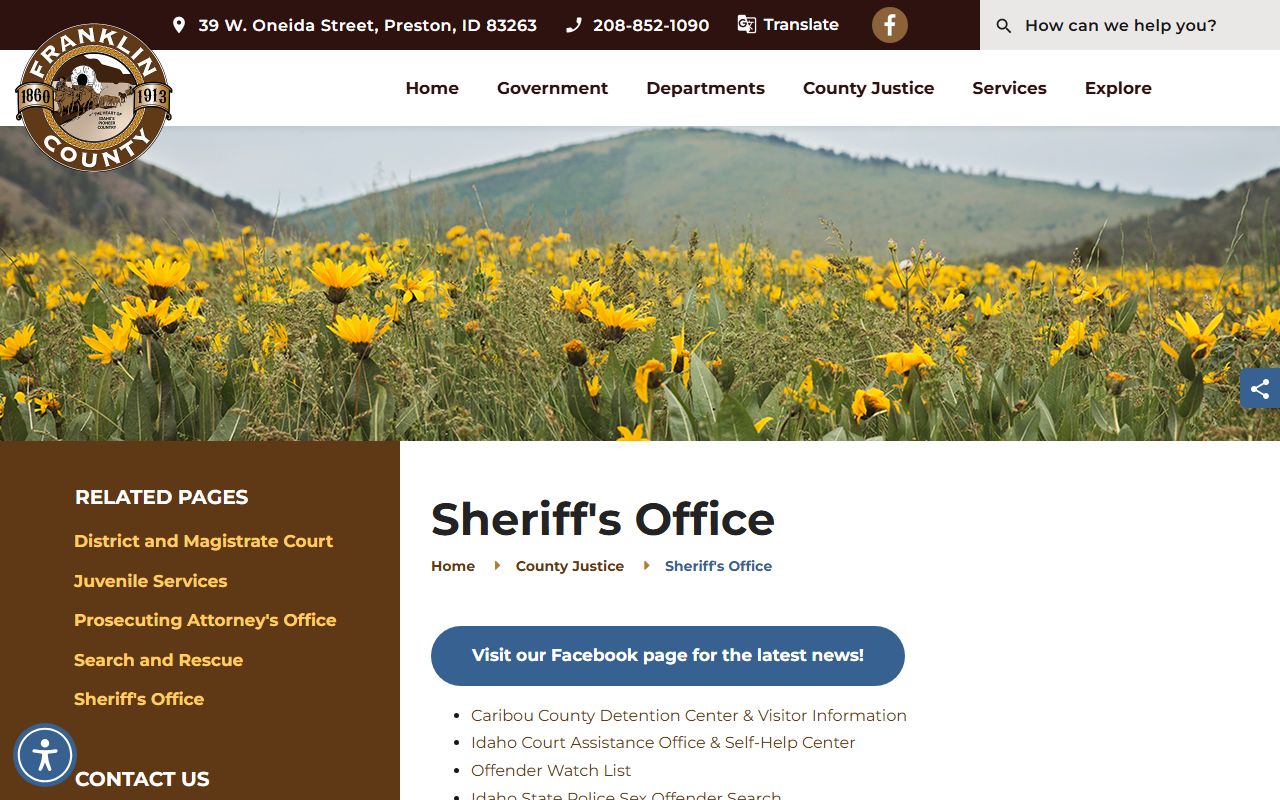
Use that sheriff channel for arrest and custody direction, then use the court and prosecutor channels to read the charges filed after the arrest.
Search Franklin County Arrest Records
There is no single official Franklin County arrest records portal in the local sources reviewed. The practical search path starts with the Franklin County Sheriff for local arrest or custody direction, then moves to Idaho iCourt for court charges after arrest. iCourt public access can show case numbers, party index entries, chronological case summaries, case status, court calendars, hearing dates, hearing locations, and public charge events. Full documents, certified copies, older files, and hearing audio may require the courthouse kiosk or the Franklin County court records request form.
The court-charge search works best when the name is entered in the portal's Last, First Middle Suffix format or when the case number is known. Franklin County District and Magistrate Court cases can involve both felony and misdemeanor matters. Felony cases generally belong to District Court, while misdemeanor, infraction, preliminary felony, traffic, juvenile, probate, family, and small claims matters often begin in the Magistrate Division of the District Court.
When the portal does not supply enough detail, the Franklin County records request form is the official copy route. The form supports inspection, copies, certified documents, and hearing audio, and it warns that records before October 1, 2018 may require an added research fee. It also notes that response may take up to three business days, with written notice if the material is not available within that period. Those request rules are useful when the public charge summary points to a filing but the actual charging document is needed.
- Call the Franklin County Sheriff at 208-852-1234 if the question is about a recent arrest, current custody, or where the person may be held.
- Open Idaho iCourt Smart Search and search by case number or defendant name, using Franklin County as a location filter when available.
- Open the public case result and read the charge entries, case status, scheduled hearings, and event history.
- Request copies from the Franklin County court clerk when the public portal does not show the document, the record is older, or certification is needed.
For statewide criminal-history research, the Idaho State Police Bureau of Criminal Identification is the official repository described in the research. BCI criminal-history records are based on fingerprint arrest records reported by Idaho criminal justice agencies. They are not the same as a Franklin County court case screen, and they may be requested through the official ISP process rather than through local court staff.
Franklin County Charge Documents
Charges after arrest become part of the court record when a charging document is filed. The legal label matters because it tells the reader how the allegation entered court. A complaint may start a criminal matter, an information is the prosecutor's formal charging document in many felony cases, and an indictment comes from grand jury action. The Franklin County Prosecuting Attorney handles state criminal charging decisions, appears in criminal court, and works with law enforcement on cases that move from arrest into prosecution.
| Document | Who Files It | Common Use | What To Check |
|---|---|---|---|
| Complaint | Law enforcement or prosecutor | Starts many criminal, misdemeanor, traffic, or infraction matters | Count number, statute citation, date filed, and initial charge level |
| Information | Prosecutor | Formal charging document in many felony cases | Whether charges were added, reduced, or amended after review |
| Indictment | Grand jury through court process | Serious or grand-jury-filed criminal matters | Issuing court, charged counts, and any sealed or restricted entries |
The manifest also includes the U.S. Attorney source for federal prosecution context from the U.S. Attorney's Office for the District of Idaho.
That federal source is useful only when a matter is federal; normal Franklin County state charges remain with Idaho trial courts and the county prosecutor.
Franklin County Charge Status
A Franklin County court charge can change after the first filing. Prosecutors may amend a count, reduce a count, dismiss one count while keeping another, or file new charges after review. iCourt may show public event history and case status, but the public view is limited under Idaho court-record rules. A missing charge entry does not always mean nothing happened. The record may be sealed, exempt, not yet entered, outside the electronic range, or available only by clerk request.
| Status | What It Means | Where It May Appear |
|---|---|---|
| Pending | The charge is still open and has not reached final disposition. | iCourt case status, hearing list, or clerk record |
| Amended or reduced | The filed charge changed, often after prosecutor review, plea talks, or court order. | Chronological case summary and charging-document history |
| Dismissed | The court or prosecution ended that charge, with or without limits on refiling. | Disposition event, order, or judgment entry |
| Nolle prosequi | The prosecution declines to proceed on a charge when allowed by the court process. | Prosecutor filing or disposition entry if public |
| Failure to appear event | A missed hearing may lead to a bench warrant or added court action. | Docket event, warrant entry, or hearing history |
Note: For older or certified Franklin County court charge records, use the courthouse kiosk or the clerk's written request process.
Franklin County Charges vs Convictions
A charge is not a conviction. A charge means the state has filed an accusation in court. A conviction means the charge ended in a guilty plea, guilty verdict, or other conviction result entered by the court. Franklin County arrest records may show the beginning of custody, and iCourt may show the charge list, but the outcome must be read from disposition, judgment, sentence, and payment entries. This difference is critical for anyone comparing an arrest, a court charge, and a final criminal record.
| Point of Comparison | Charge | Conviction |
|---|---|---|
| Stage | Filed allegation after arrest or citation | Final result after plea, verdict, or judgment |
| Proof level | Based on probable cause and prosecutorial filing | Based on guilty plea, trial verdict, or court judgment |
| Record fields | Count, statute, severity, status, filing date | Disposition, sentence, fines, probation, jail, or other terms |
| Public meaning | Does not prove guilt | Shows the court outcome for that count |
Franklin County Criminal History Checks
Statewide systems serve different purposes than Franklin County arrest records. The Idaho State Police BCI page describes the central repository for fingerprint arrest records reported by Idaho criminal justice agencies. It can support formal criminal-history checks, but it is not a substitute for reading a Franklin County court case. Court records show filings, hearings, dispositions, sentences, and clerk-controlled documents. BCI history is a state criminal-history product. IDOC search is a custody and supervision status tool for people under Idaho Department of Correction jurisdiction.
The manifest IDOC image was captured from the Idaho Department of Correction resident/client search results sample.
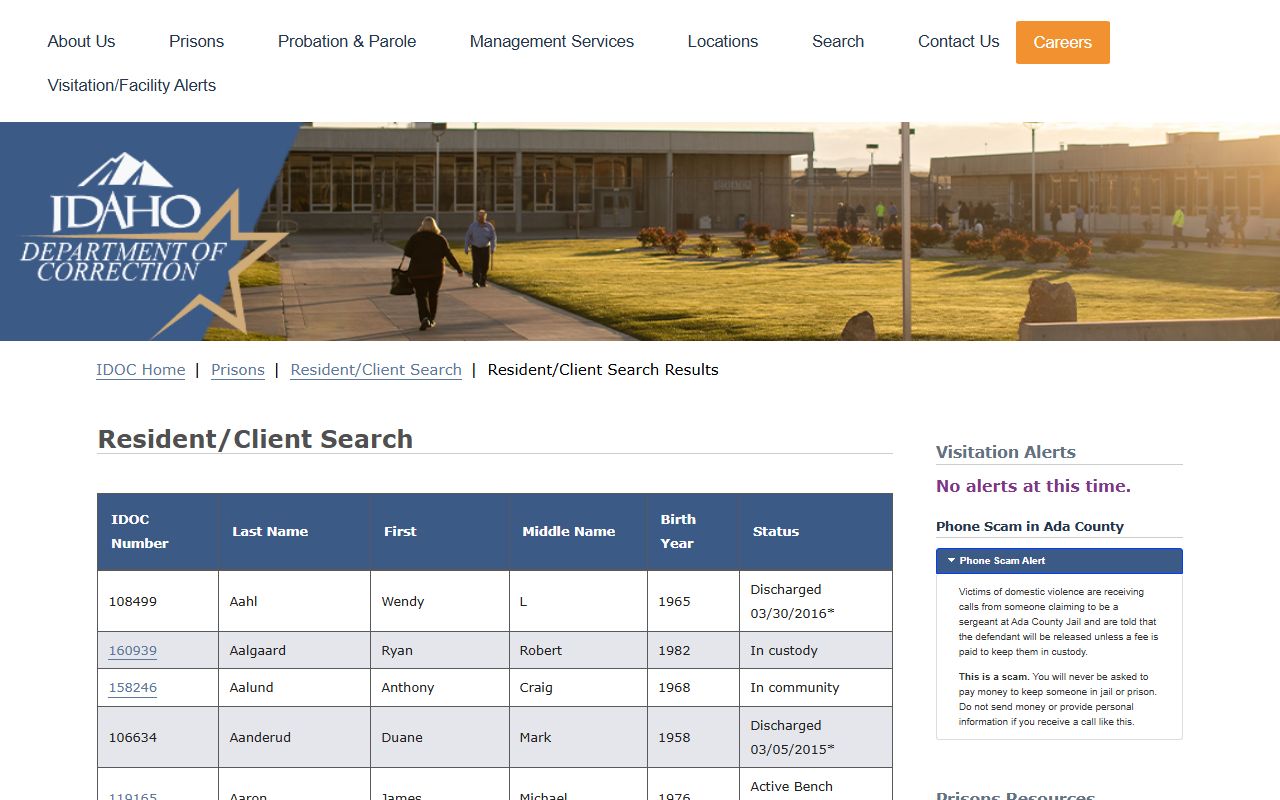
IDOC results may show an IDOC number, name, birth year, and status, including custody, community, discharge, or active bench warrant examples, but they do not replace local court charge records.
Restricted Franklin County Charge Records
Idaho public-record rules do not make every arrest or charge detail public. Idaho Code 74-105 limits some law-enforcement and investigatory records, which affects active investigations, sheriff reports, informants, sealed warrants, and some arrest material. Idaho Court Administrative Rule 32 controls public access to court records, and the iCourt portal states that sealed cases, sealed records, and exempt event entries do not appear in public results.
Juvenile records have their own limits under Idaho Code 20-525. Personal identifiers are also redacted from public court access, including social security numbers, addresses, telephone numbers, driver license numbers, financial account numbers, and similar data. A missing result may mean the record is sealed, confidential, outside the electronic period, or held only through the clerk request process.
Set-aside or sealing questions should be handled through the court process, not by trying to bypass the public portal. Idaho Court Assistance materials include Set Aside forms, and Franklin County filings must be routed through the local court clerk. If access to a charge record is denied, the proper next step is to work through the custodian or judge procedure that applies to the record type.
Important: Do not use arrest or charge information for FCRA-regulated screening without a lawful consumer-reporting process.